
Direct Connect Auto Transport had over 900 non-indexed pages on their website when we started working with them.
That’s not a typo.
900+ pages that existed on the site but that Google had decided, for various reasons, were not worth showing anyone.
And most of those pages were actively hurting the pages that should have been ranking.
What “Non-Indexed” Actually Means
When people hear SEO, they usually think keywords and content. Both matter. There’s also a more foundational layer that most service businesses never look at: whether Google can actually find, crawl, and make sense of their site in the first place.
Non-indexed means Google has seen a page but decided not to include it in search results. Too thin, too similar to another page, broken, orphaned, or has legacy pages from three website builds ago that nobody deleted.
Here’s why that matters: Google has a crawl budget for every site. It can only spend so much time and attention on your pages before it moves on. If that budget is diluted across 900+ low-value URLs, it has less attention to spend on the pages that actually drive revenue.
Your state pages, your service pages, your route content. The pages that convert.
What We Did
We started with a full index audit: what’s indexed, what’s not, and why.
Then we got surgical about cleanup.
Legacy “-old” pages competing with live URLs: redirected or removed.
Broken internal links pointing to 404 pages: fixed.
Low-value and duplicate pages with no strategic purpose: consolidated.
WordPress backend clutter that had accumulated across years of different hands touching the site: cleaned.
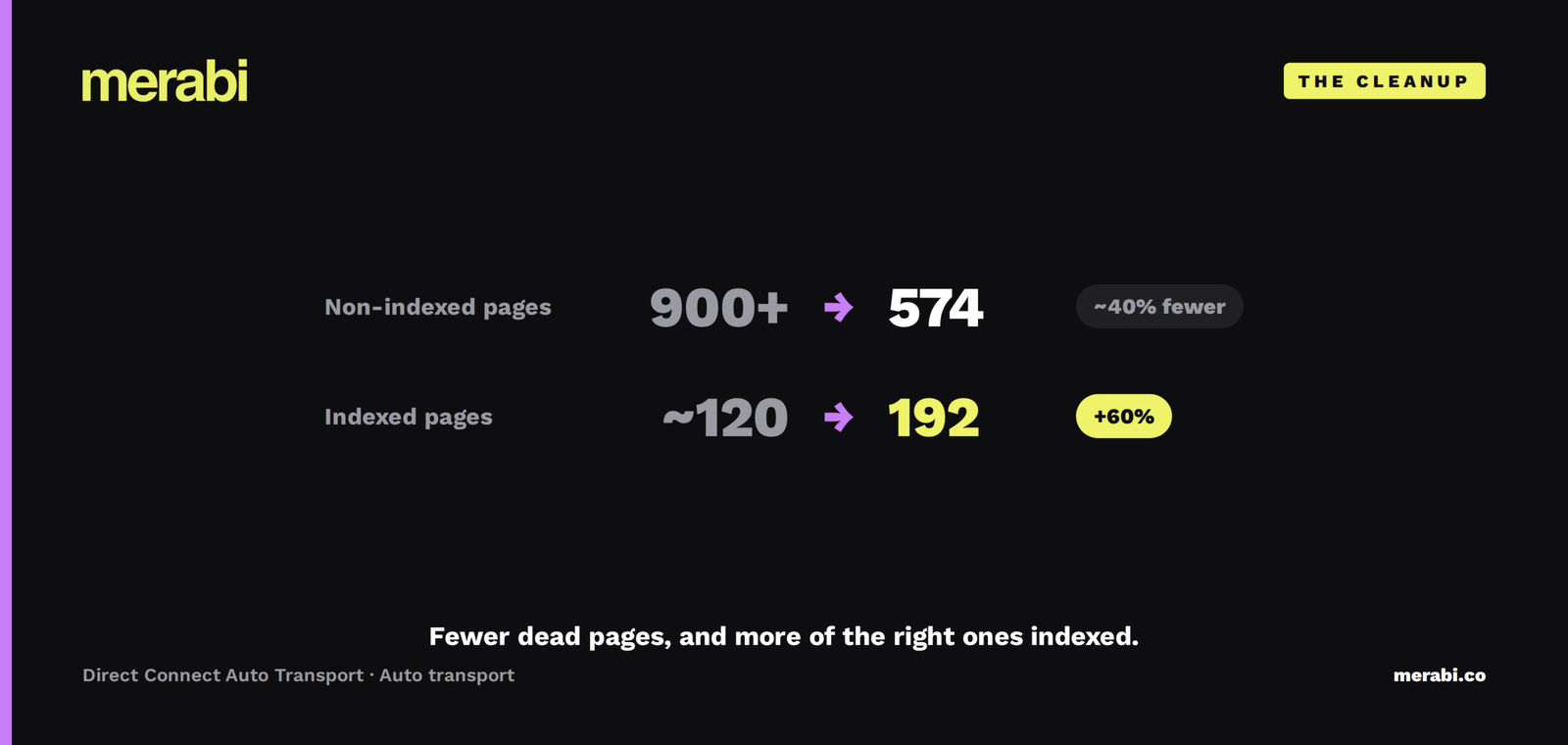
Non-indexed URLs went from 900+ to 574. That’s roughly a 40% reduction. Indexed pages increased by about 60%, from around 120 to 192.
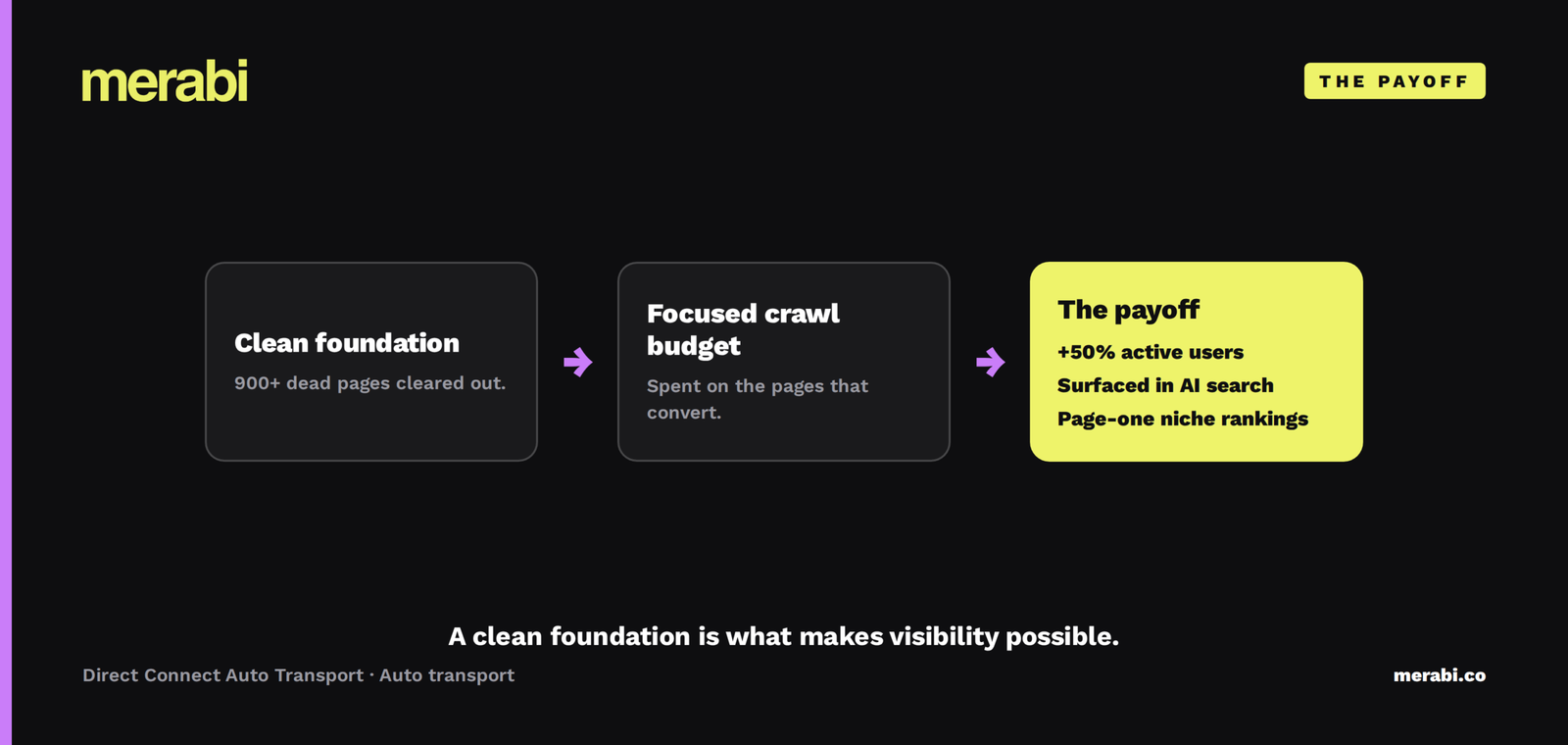
More importantly, crawl budget stopped being spread thin. It started concentrating on the pages that actually mattered.
What Happened After
Active users increased by roughly 50% in the 90-day window after the cleanup.
The site started appearing in Google AI Overviews, ChatGPT, Gemini, and Perplexity for relevant queries.
Page-one rankings in niche categories: travel nurse car shipping, military auto transport, New York auto transport.
Here’s what’s interesting about the AI search visibility piece. DCAT wasn’t holding universal page-one rankings for every keyword. AI systems started surfacing their content anyway.
AI systems prioritize clear topical explanations, structured content, and reduced duplication. That’s exactly what a properly cleaned-up and organized site produces. DCAT’s hybrid/EV, military, and travel nurse content met those criteria, even while classic SERP rankings were still maturing.
The Lesson for Non-Logistics Businesses
You don’t need to be in auto transport for this to apply.
Any service business website accumulates technical debt over time. Pages from old campaigns. Blog posts that were published once and never updated. Duplicate service pages from a site redesign that kept everything “just in case.”
That clutter limits your visibility before any content strategy can take effect.
You can write the best content in your industry. If Google can’t figure out what your site is actually about, the content doesn’t get seen.
Cleanup is the least exciting part of content marketing. It’s also the thing that often makes everything else work.
If you’re posting content but not seeing traction, look underneath it. The foundation might be the thing holding you back.
What does your site’s foundation actually look like?
Book a free strategy call. We’ll look at what’s indexed, what’s buried, and what’s quietly holding your rankings back.
Once the foundation is solid, The 30-Minute Content System shows you how to build a full quarter of content on top of it.